
- 科目一考试
- 顺序练习
- 随机练习
- 强化练习
- 模拟考试
- 科目四考试
- 顺序练习
- 随机练习
- 强化练习
- 模拟考试
- 外国语言版题库
- 英语题库
- 德语题库
- 韩语题库
- 日语题库
- 俄语题库
- 法语题库
- 西班牙语题库
- 阿拉伯语题库
- 摩托车英文题
江西只认识英文可以考科目四吗
-
1、The broken yellow line in the center of the road indicates that overtaking by crossing the line is permitted in safe situations.
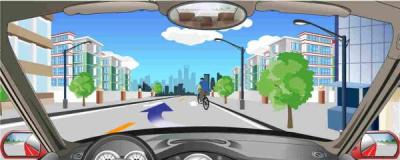
Answer:Y
2、If a fast moving vehicle has a steering failure, using emergency braking can easily cause an overturn.
Answer:Y
3、The sign on the right warns of a winding road to the left ahead.
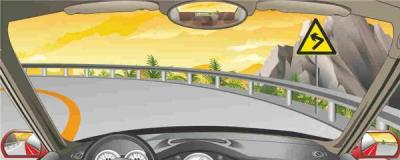
Answer:N
4、What should the driver do if he/she encounters this situation at the intersection when driving straight?
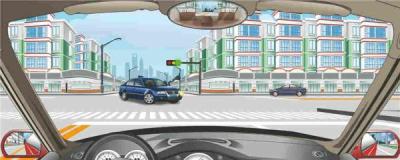
A、Sound the horn to warn the other vehicle to yield
B、Speed up and pass in the front of the vehicle
C、Turn on the headlamp to warn the other vehicle to yield
D、Slow down or stop to yield
Answer:D
5、Which of the following acts are prohibited when passing through a tunnel?
A、Overtaking
B、Stopping
C、Making a U-turn
D、Reversing
Answer:ABCD
6、Motor vehicles are permitted to move to the right lane at this intersection.
Answer:N
7、When a motor vehicle breaks down and cannot be moved away from the expressway, the driver and all passengers should stay in the vehicle and wait for the rescue personnel.
Answer:N
8、How should lamps be used by the motor vehicle driver who follows a vehicle on a road section where he street light condition is good?
A、Turn off the headlamp
B、Use high-beam
C、Turn off all lamps
D、Use low-beam
Answer:D
9、This sign warns that the section ahead is under traffic monitoring.
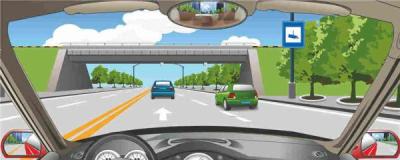
Answer:Y
10、How should lamps be used when setting off in this situation?
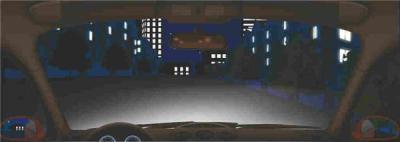
A、Turn on the high-beam
B、Turn on the left indicator only
C、Turn on the left indicator and low-beam
D、Turn on hazard lamp
Answer:C
11、The driver should take emergency evasion measures when the motor vehicle suddenly self-ignites. Which ones of the following methods are correct?
A、Spray clean water to extinguish the fire
B、Report to the police
C、Use the spare fire extinguisher in the vehicle to put out the fire
D、Set up a warning sign in the oncoming direction
Answer:BCD
12、The sign on the right indicates a passing bay ahead.
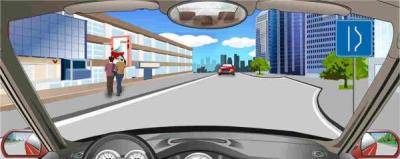
Answer:Y
13、Motor vehicle drivers should rush to the top of the slope in this situation.
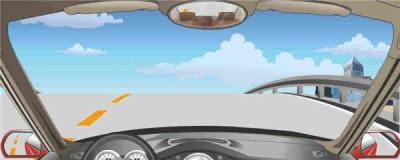
Answer:N
14、When the tire pressure is too low, what will happen if the tire changes its shape in waves and increases in temperature due to fast movement?
A、Unstable tire pressure
B、Even lower tire pressure
C、Driving resistance increases
D、Tire burst
Answer:D
15、The sign on the left warns of no passing on the right-hand road ahead.
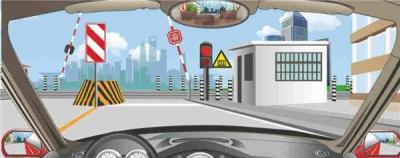
Answer:N
16、What should the driver do upon finding that one ofthe right tires is leaking while driving?
A、Brake swiftly to slow down
B、Brake slowly to slow down
C、Turn to the left side swiftly
D、Apply emergency braking
Answer:B
17、Two parallel broken double-yellow lines indicate the position of a diversion lane.
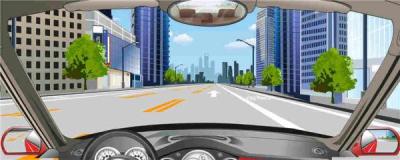
Answer:Y
18、How to ensure motor vehicles have sufficient power when driving uphill?
A、Downshift before reducing speed
B、Downshift after reducing speed
C、Downshift when the speed is excessively low
D、Downshift to the fullest extent
Answer:A
19、The main impact of muddy roads on safe driving is that the wheels may easily spin and skid
Answer:Y
20、When a motor vehicle passes over an inundated road drivers should change to a high gear and pass rapidly.
Answer:N
21、Under such circumstances, what should be done by the motor vehicle driver?
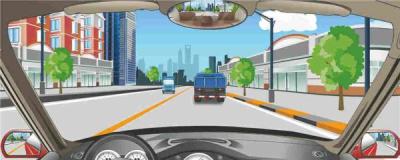
A、Overtaking the vehicle in front on its left
B、Overtaking by occupying the opposite lane
C、Overtaking the vehicle in front on its right
D、Following the vehicle in front
Answer:D
22、How should the driver pass this place safely?
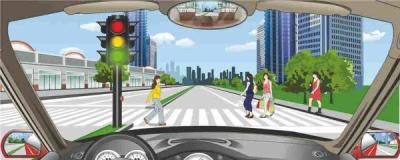
A、Speed up and pass in the front of the pedestrians
B、Bypass behind the pedestrians
C、Slow down and sound the horn
D、Stop and wait until the pedestrians pass
Answer:D
23、The yellow broken line on the curb indicates that vehicles are not allowed to stop and let passengers embark or disembark or load and unload freight at the roadside.
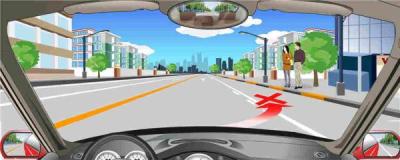
Answer:N
24、When a motor vehicle enters an expressway from the ramp, which of the following lamps should be turned on?
A、The left-turn indicator
B、The right-turn indicator
C、The hazard warning lamp
D、The headlamp
Answer:A
25、When driving in rain and encountering pedestrians with umbrellas or wearing raincoats, what should be done by motor vehicle drivers in order to yield?
A、Drive at a normal speed
B、Sound the horn to alert when approaching the pedestrians
C、Speed up and bypass on the left
D、Reduce speed and sound the horn in advance
Answer:D
26、As shown in the flash, the motor vehicle chooses a correct way to pass through the level crossing.
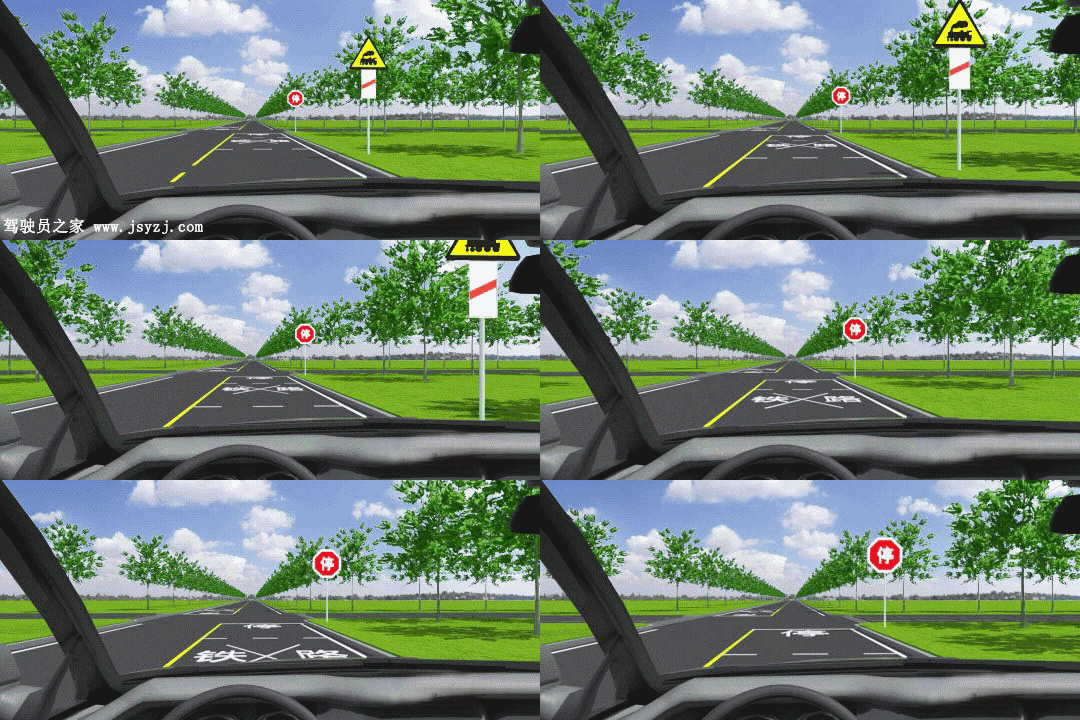
Answer:Y
27、hen there is a braking failure on a downhill road the driver should immediately try to find and drive to an emergency lane; after stopping the vehicle on the emergency lane, the driver should pull up the stopping brake so as to prevent a second danger arising from the vehicle sliding.
Answer:Y
28、The sign on the right warns of a village or town ahead suggesting a 30km/hour speed.
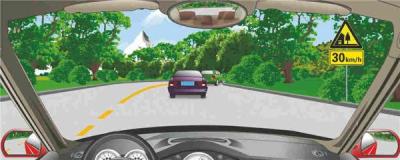
Answer:Y
29、Mr. Tang drove a large bus with 74 passengers (capacity 30 people). When descending a long curving slope at a speed of 38 kilometers per hour, the bus overturned to a brook beside the road. As a result of the accident, 17 people were killed and 57 people injured. What's the main illegal act committed by Mr. Tang?
A、Driving after drinking
B、Carrying more passengers than permitted
C、Fatigued driving
D、Speeding
Answer:BD
30、What should be done by drivers in order to drive safely on the road in this condition?
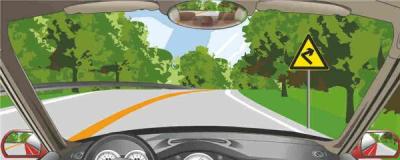
A、Make a large turn on the left side of the road
B、Make a turn on the central line of the curve
C、Make a small turn on the right side of the road
D、Make a turn by borrowing the opposite lane
Answer:C
31、When driving on an expressway, which of the following statements is correct?
A、Drives may overtake on either the ramp, the acceleration lane or the deceleration lane
B、Drives are prohibited from reversing, driving in the opposite direction or making a U turn by crossing the central dividing strip
C、Drivers may drive on the emergency lane in a non-emergency case
D、Drives may test a motor vehicle or learn to drive
Answer:B
32、The sign on the right indicates the location of the highway emergency phone.
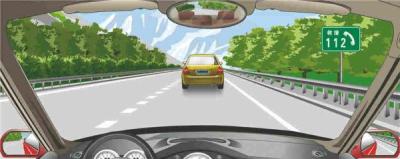
Answer:N
33、Drivers may temporarily cross these central broken and solid yellow lines when overtaking.
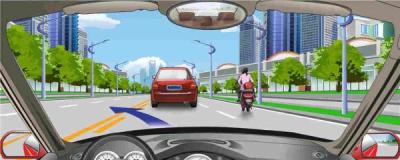
Answer:Y
34、When driving in thick or extremely thick fog, what should the driver do due to the low visibility in such weather?
A、Turn on the headlamp and drive slowly
B、Turn on the fog lamp and drive slowl
C、Park in a safe place
D、Drive slowly close to the roadside
Answer:C
35、When a wounded person is unable to get off the vehicle by himself/herself, he/she should be removed from the vehicle so as to avoid a secondary injury.
Answer:Y
36、Drivers may turn left when traffic police give these hand signals.
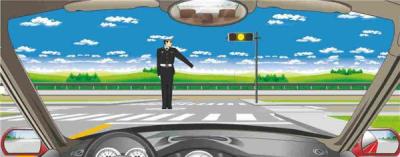
Answer:N
37、Which of the following measures is correct for rescuing a person sustaining full-body burns?
A、Cover the fire with sandy soil
B、Spray cool water to his body
C、Put out the fire by extinguisher
D、Help to remove the burning clothes
Answer:B
38、When a bicycle borrows the motor vehicle lane, the motor vehicle may sound the horn hurriedly to warn the bicycle to yield.
Answer:N
39、When there is a braking failure, the driver should first control the direction and then try to control the speed.
Answer:Y
40、When temporarily parking on a raining day, what kind of lamp should the driver turn on?
A、Front and back fog lamps
B、Hazard warning lamp
C、Headlamp
D、Reversing lamp
Answer:B
41、What should the driver do when the motor vehicle encounters this situation?
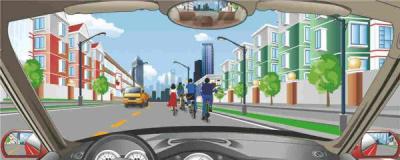
A、Overtake immediatel
B、Sound the horn continuously to warn
C、Maintain safety distance and overtake
D、Sound horn and speed up to overtake
Answer:C
42、What should the driver do if he/she encounters pedestrians in this situation at an intersection?
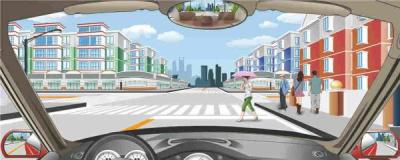
A、Slow down promptly and stop to yield
B、Sound the horn to warn the pedestrians to yield
C、Speed up and pass in front of the pedestrians
D、Turn on the headlamps to warn the pedestrians to yield
Answer:A
43、When encountering this situation around a school, the driver should speed up and pass as quickly as possible.
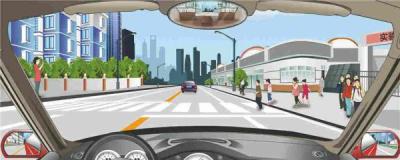
Answer:N
44、Mr. Zou drove a large sleeper coach (capacity 35 people and carrying 47 passengers). At the spot of 938 kilometers of the Jinggang'ao Expressway, large amounts of dangerous chemicals in the coach blew up, killing 41 people and injuring 6. What are the main illegal acts in this case?
A、Carrying more passengers than permitted
B、Passengers carried flammable and explosive substances
C、Speeding
D、Illegal parking
Answer:AB
45、If a motor vehicle deviates from the straight direction due to steering failure, what should be done by thedriver in order to reduce speed and stop the vehicle as soon as possible?
A、Gently depressing the brake pedal
B、Pulling up the handbrake
C、Immediately changing to a low gear to reduce speed
D、Decisively and continuously depressing and releasing the brake pedal
Answer:D
46、When rescuing a wounded person suffering from bone fracture, which of the following should be kept in mind?
A、Immediately send him/her to the hospital on a stretcher
B、Properly change the original posture when the injured person wounded
C、Dress the fracture with a bandage
D、Do not move the fractured body-part
Answer:D
47、As shown in this picture, the intersection guide line is designed to help drivers make turns.
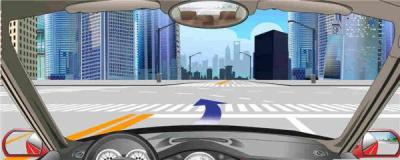
Answer:Y
48、Which one of following ways is the safest when driving a motor vehicle on this road?
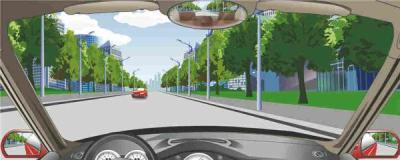
A、Driving along the central line of the road
B、Driving along the right side of the road
C、Driving at the middle of the road
D、Driving along the left side of the road
Answer:B
49、How should a motor vehicle follow the other vehicle In front when driving on a road covered with ice and snow?
A、Keep a long safe distance
B、Turn on hazard lamp
C、Change between high-and-low beam alternatively
D、Sound the horn in due time to give a notice to the vehicle in front
Answer:A
50、When encountering this situation in a residential area, the driver should follow them closely.
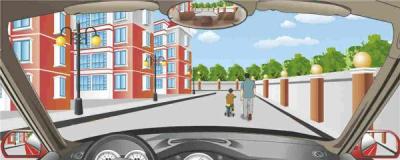
Answer:N
- 江西只认识英文可以考科目四吗 相关内容
- 江西科目四英文版题目 河北考驾照的英文单词 宁夏科目一考试英文版 安徽驾校考试英文版 辽宁驾考有英文版吗 四川考驾照的英文单词 辽宁科目四考题英文版 四川驾考科目一英语版PDF题库 西藏考驾照科目四有英文版 宁夏驾照科目四英文版题库 驾考科目四英文版题库 湖北驾考科目四英语 老外考驾照的理论考题有哪些内容和题目 driving test english 江西科目一英文版在哪里找 天津驾考科目四英语
Copyright © 2025 驾考 版权所有