
- 科目一考试
- 顺序练习
- 随机练习
- 强化练习
- 模拟考试
- 科目四考试
- 顺序练习
- 随机练习
- 强化练习
- 模拟考试
- 外国语言版题库
- 英语题库
- 德语题库
- 韩语题库
- 日语题库
- 俄语题库
- 法语题库
- 西班牙语题库
- 阿拉伯语题库
- 摩托车英文题
都匀摩托车驾照考试科目四英语题
-
1、The continuously flashing yellow light is to warn that the driver should look and make sure it is safe to pass.
Answer:Y
2、What is the meaning of this sign?
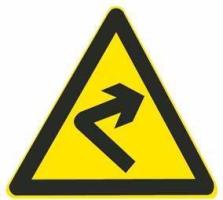
A、Sharp right curve
B、Bypass from right side
C、Continuous curves
D、Sharp left curve
Answer:A
3、What is the meaning of this sign?
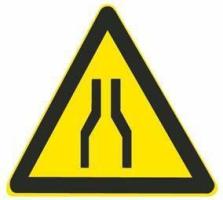
A、Road narrows on both sides
B、Road narrows on the right side
C、Road narrows on the left side
D、Bridge narrows
Answer:A
4、When driving on road sections where safe sight distance is affected, such as the top of a ramp, what should drivers do to ensure safety?
A、Rush through
B、Use hazard lamp
C、Cut speed and sound the horn
D、Drive at will
Answer:C
5、What is the meaning of this sign?
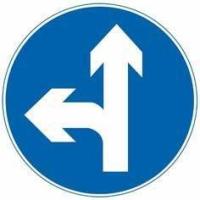
A、Going straight and right turn
B、Going straight and left turn
C、No going straight and no left turn
D、Right turn and left turn only
Answer:B
6、When approaching a vehicle on a narrow slope, which one of the following ways is correct?
A、The descending vehicle yields to the ascending
B、The vehicle which is further from the slope crest should yield
C、The ascending vehicle yields to the descending
D、If the descending vehicle has reached the midpoint while the ascending vehicle has not yet set out, the descending vehicle must yield.
Answer:A
7、What is the meaning of this sign?
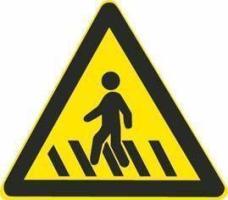
A、Speed up when the driver can not see the pedestrians
B、Speed up
C、There is a crosswalk ahead.
D、Keep driving at the same speed when you can not see the pedestrians
Answer:C
8、When a motor vehicle passes over an inundated road drivers should change to a high gear and pass rapidly.
Answer:N
9、When encountering such pedestrians, what should motor vehicle drivers do?
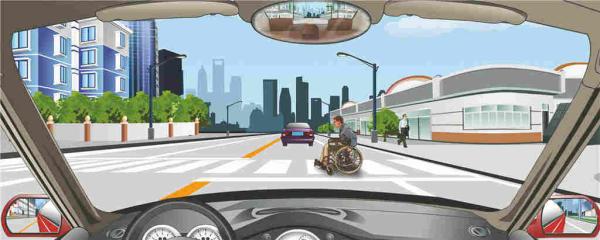
A、Bypass in front of the pedestrians
B、Bypass from behind the pedestrians
C、Sound the horn to alert the pedestrians
D、Voluntarily stop and yield
Answer:D
10、When driving on a foggy day, the driver should turn on the fog lamp.
Answer:Y
11、After a tire blows out and before the driver can control the speed of the vehicle, he should refrain from using the foot brake to stop the vehicle. Otherwise, a horizontal swing of the vehicle can cause greater danger.
Answer:Y
12、When a motorcycle goes down a long slope, it should run at a lower gear and fully use the engine to brake.
Answer:Y
13、When encountering a school bus which stops at the right roadside and students are embarking or disembarking, what should motor vehicle drivers do?
A、If there is only one motor vehicle lane in each direction, motor vehicle drivers behind the bus should stop and wait.
B、If there are two motor vehicle lanes in each direction, motor vehicle drivers in the left lane behind the bus may overtake the bus at a lower speed
C、If there are three motor vehicle lanes in each direction, motor vehicle drivers in the middle lane behind the bus should stop and wait
D、If there are three motor vehicle lanes in each direction, motor vehicle drivers in the left lane behind the bus may pass at a lower speed
Answer:ACD
14、When driving, the driver should yield to _______.
A、Ambulance
B、Fire engine
C、School bus
D、Police car
Answer:ABCD
15、While driving a motorcycle, it is permitted to keep one hand on the handlebar but not allowed two hands leave handle bars at the same time.
Answer:N
16、When encountering non-motorized vehicles cutting in on the road, the driver should ________.
A、Honk to warn
B、Speed up and bypass from the front
C、Voluntarily reduce speed and yield
D、Suddenly speed up when approaching
Answer:C
17、When a fast-moving vehicle encounters an emergency the driver should turn to evade first and then brake to slow down so as to mitigate the damage.
Answer:N
18、Whats the meaning of the double white solid lines in far front of the intersection?
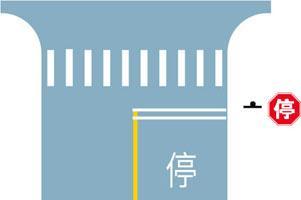
A、Stopping and yield line
B、Slowdown and yield line
C、Left-turn waiting line
D、Waiting to run line
Answer:A
19、When there is no bondage for rescuing a wounded person, towels, handkerchiefs, bed sheets and stockings can be used for dressing.
Answer:Y
20、Under such circumstances, motor vehicle drivers should stop and yield
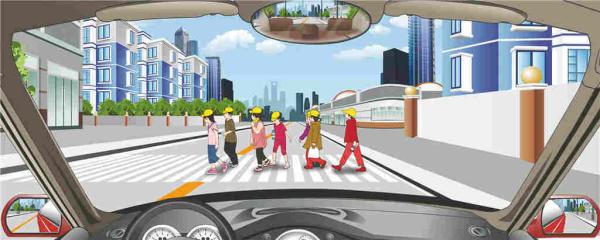
Answer:Y
21、When driving in icy and snowy weather, ________.
A、The tires can easily spin
B、The braking distance becomes longer
C、The tires can easily drift
D、Vehicle handling becomes more difficult
Answer:ABCD
22、The drivers, loaders and supercargoes responsible for dangerous chemicals transportation should all full understand the chemical characteristics, potential risks, features of the packaging containers and emergency measures for any unexpected accidents.
Answer:Y
23、When driving a motor vehicle near an intersection, the vehicle may speed up and honk to pass.
Answer:N
24、What is the meaning of this sign?
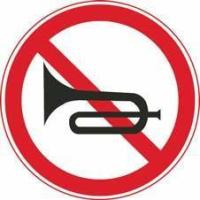
A、No long time honking
B、Honk discontinuously
C、Reduce speed and honk
D、No honking
Answer:D
25、When the engine suddenly stalls on the road, what should the driver do?
A、Stop the vehicle and overhaul it immediately
B、Immediately turn on the hazard lamps
C、Move the vehicle to a place where it will not obstruct the traffic flow
D、Set up a breakdown warning sign
Answer:BCD
26、When driving on a road covered with ice and snow, drivers tend to encounter glare caused by reflection of light rays from the road surface.
Answer:Y
27、When the driver discovers a tire is leaking and steers the vehicle off the main carriageway, he should refrain from applying emergency so as to avoid a vehicle turnover or a rear-end collision arising from the late braking of the following vehicle.
Answer:Y
28、What is the most frequent problem for driving on a muddy road?
A、High resistance force
B、Sideways slide
C、The motor vehicle bumps
D、Steering failure
Answer:B
29、When passing a turn or a curve section, the driver should slow down and disengage the clutch.
Answer:N
30、When passing an intersection, vehicle motor drivers are not allowed to overtake.
Answer:Y
31、What kind of harmful effect will be brought about by continuously using the foot brake on a long downhill road?
A、Shorten the engine’s service life
B、Make the driver feel tired
C、Easily cause the vehicle to overturn
D、Reduce the braking efficiency
Answer:D
32、It is illegal to change lanes without turning on indicators.
Answer:Y
33、When a motor vehicle passes over an overflowing bridge, what should the driver do after stopping and observing closely?
A、Change to a high gear and pass rapidly
B、Constantly observe the changes of the flow
C、Prepare to stop at any time
D、Change to a low gear and pass through at a constant speed
Answer:D
34、When finding a tire burst on the road, the driver should gently depress the brake pedal, reduce speed and stop the vehicle slowly.
Answer:Y
35、Drivers neednt yield to pedestrians who display such behavior.
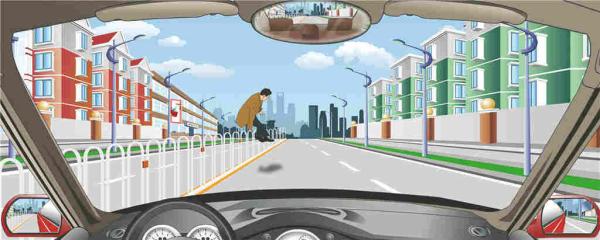
Answer:N
36、Once inflammable gas causes a fire disaster, it should be put out with water in good time.
Answer:N
37、Which of the following method is correct to rescue an unconscious person?
A、Apply cardio-pulmonaryresuscitation immediately
B、Press the philtrum of the wounded person with force
C、Continuously slap the face of the wounded person
D、Check the breath of the wounded person before other emergency treatments
Answer:D
38、You can make an U turn at this intersection.
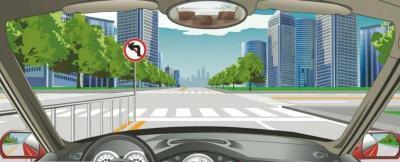
Answer:N
39、When following a vehicle on the road, the distance from the vehicle in front is not important. As long as the driver goes forward at the same speed as the vehicle in front does, he/she can avoid a rear-end collision.
Answer:N
40、When approaching another vehicle at night, why should the driver alternate between high-and-low-beam at a distance more than 150 meters?
A、Warn each other before passing
B、Driving habit
C、Easy to observe the situation ahead from either side
D、Courtesy
Answer:C
41、How should lamps be used when a motor vehicle meets an oncoming bicycle on a narrow road or a narrow bridge at night?
A、Continuously change between low-beam and high-beam
B、Use clearance lamp
C、Use high-beam
D、Use low-beam
Answer:D
42、During normal driving, the driver should do his/her best to run close to or on the central line so as not to allow oncoming vehicles any opportunity to occupy his own route.
Answer:N
43、Motor vehicle drivers may borrow a special lane for other vehicle types, if one exists, to overtake.
Answer:N
44、While driving a motorcycle, nothing is permitted to hang on the handlebars.
Answer:Y
45、When rescuing a wounded person suffering from bone fracture, which of the following should be kept in mind?
A、Immediately send him/her to the hospital on a stretcher
B、Properly change the original posture when the injured person wounded
C、Dress the fracture with a bandage
D、Do not move the fractured body-part
Answer:D
46、What is the meaning of this sign?
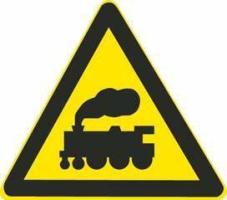
A、Watch for long time honking
B、An unmanned level crossing
C、A manned level crossing
D、Multi-crossing of railway and road
Answer:B
47、What marking is the road mark?
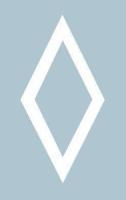
A、Crosswalk ahead
B、Intersection ahead
C、Reduce speed and yield ahead
D、Stop to yield ahead
Answer:A
48、Which of the following is a bad habit when changing lanes?
A、Turning on the indicator in advance
B、Observing closely before changing a lane
C、Change lanes at will
D、Not obstructing the passing of other normally moving vehicles
Answer:C
49、When a vehicle stops temporarily at the roadside at night, the wrong measure is to ______.
A、Turn on the warning flash light
B、Turn on the contour light
C、Turn on the high beam light
D、Turn off all lights
Answer:CD
50、Driving a motor vehicle in the downhill section of a mountain road avoids overtaking as much as possible because _______.
A、Vehicle resistance in downhill section is very high
B、Vehicles on downhill sections are more difficult to control than on flat roads due to gravity.
C、In downhill section, the front speed is faster and it is difficult to overtake.
D、Vehicles on downhill sections tend to be too fast due to gravity
Answer:BD
- 都匀摩托车驾照考试科目四英语题 相关内容
- 玉林摩托车驾照考试英文题库 永州用英文考摩托车驾驶证 泸州外国人考摩托车驾照 吴忠用英语考摩托车驾照科目四 秦皇岛摩托车驾照考试科目一英语题 漳州外国人考摩托车驾照 沧州摩托车驾照考试英文题库 鄂尔多斯摩托车英语考试题 海西州摩托车驾照考试科目一英语题 邢台外国人考摩托车驾照 湘潭摩托车驾考英语手机APP 北京摩托车考试英语题库 六安摩托车驾照理论试题英语版 芜湖用英文考摩托车驾驶证 贺州摩托车考试英语理论试题 玉溪摩托车驾考英语手机APP
Copyright © 2025 驾考 版权所有