
- 科目一考试
- 顺序练习
- 随机练习
- 强化练习
- 模拟考试
- 科目四考试
- 顺序练习
- 随机练习
- 强化练习
- 模拟考试
- 外国语言版题库
- 英语题库
- 德语题库
- 韩语题库
- 日语题库
- 俄语题库
- 法语题库
- 西班牙语题库
- 阿拉伯语题库
- 摩托车英文题
上海驾考科目三英文
-
1、When going straight or turning right, drivers are not allowed to drive on or across the guide lines on both sides of the intersection.
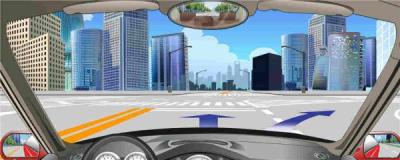
Answer:Y
2、When a motor vehicle passes over an overflowing bridge, what should the driver do after stopping and observing closely?
A、Change to a high gear and pass rapidly
B、Constantly observe the changes of the flow
C、Prepare to stop at any time
D、Change to a low gear and pass through at a constant speed
Answer:D
3、The sign in front indicates the allocation of roads ahead.
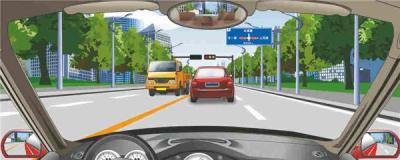
Answer:N
4、Mr. Zhou drove a light van (with 22 passengers) on the Bingcha Highway. At the spot of 79 kilometers mark by 150 meters of the highway, the van fell into the valley on one side, killing 12 people and injuring 10. What's the main illegal act committed by Mr.Zhou?
A、Driving a motor vehicle having failed to accept inspection in time
B、Carrying passengers on a freight motor vehicle
C、Speeding
D、Fatigued driving
Answer:B
5、The sign on the right warns that there are vehicles converging into the intersection on the right.
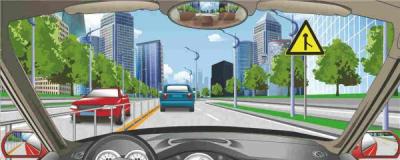
Answer:Y
6、The sign in front gives information about the direction of road exits.
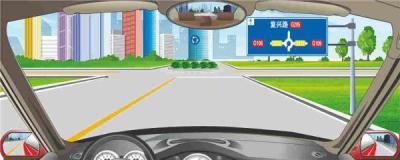
Answer:Y
7、When the engine suddenly stalls on the road, what should the driver do?
A、Stop the vehicle and overhaul it immediately
B、Immediately turn on the hazard lamps
C、Move the vehicle to a place where it will not obstruct the traffic flow
D、Set up a breakdown warning sign
Answer:BCD
8、When a motor vehicle encounters a group of youngsters bypassing the motor vehicles parking beside the road, the driver should slow down voluntarily and yield.
Answer:Y
9、The sign on the right warns of a dangerous mountainside road ahead.
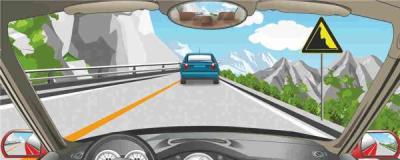
Answer:Y
10、When driving on the highway in foggy, rainy, or snowy weather with a range of visibility between 100 meters and 200 meters, what should motor vehicle drivers do?
A、Turn on the fog lamp, low-beam, clearance lamp and front and rear position lamp
B、Drive at a speed of no more than 60 km/hour
C、Keep a breaking distance of more than 100 meters from the vehicle in front in the same lane
D、Leave the highway from the nearest exit as soon as possible
Answer:ABC
11、As shown in this flash, what should the motor vehicle driver do when encounters this situation?
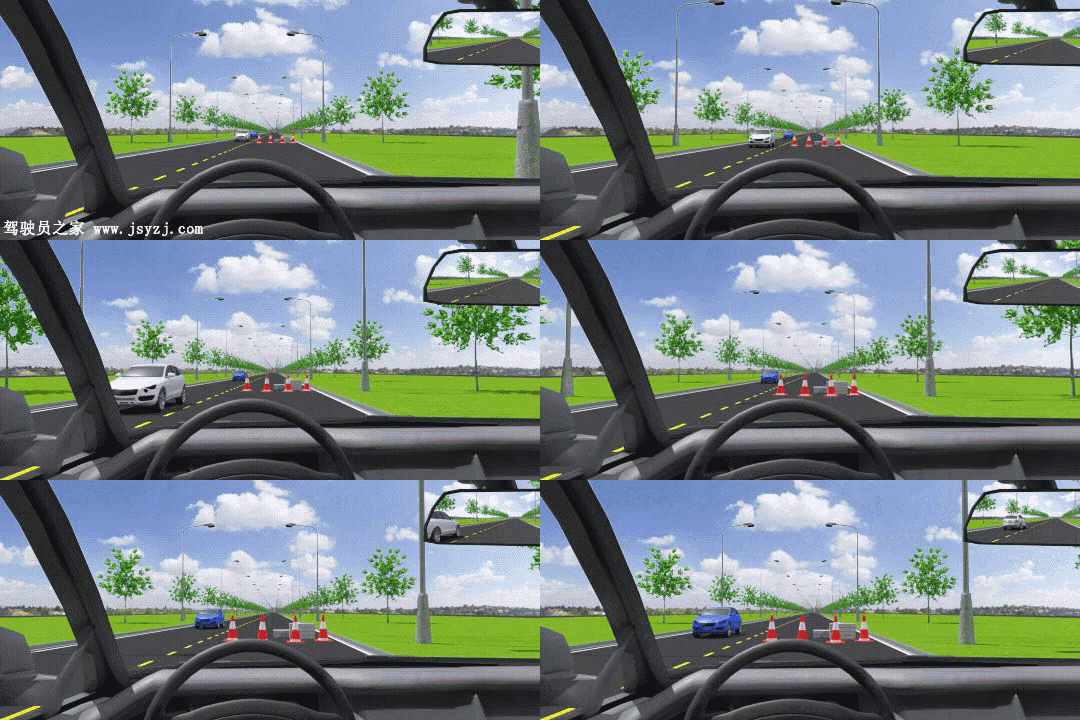
A、Use the mergency brake
B、Turn sharply and pass rapidly
C、Slide over rapidly without encountering collision
D、Stop smoothly
Answer:D
12、Under such circumstances, what should the motor venicle driver do?
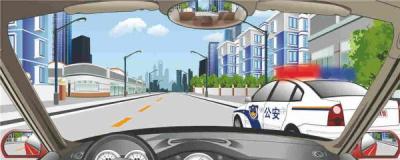
A、Reduce speed and yield by the left side
B、Reduce speed and yield by the right side
C、Speed up and yield by the left side
D、Go ahead along the original route
Answer:A
13、Motor vehicles should stop and wait when encountering two red lights flashing alternately at evel crossings.
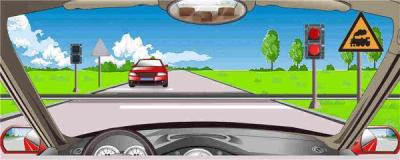
Answer:Y
14、What should the driver pay attention to when the motor vehicle passes a school?
A、Observe the traffic signs and markings
B、Slow down and pass slowly
C、Prohibited from sounding the horn
D、Pass rapidly
Answer:ABC
15、Before a motor vehicle enters a tunnel, the driver should adjust the speed in accordance with the indication of the traffic sign at the entrance of the tunnel.
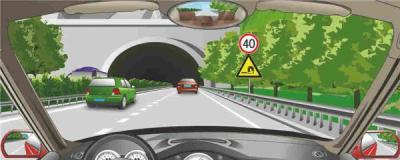
Answer:Y
16、When a motor vehicle has deviated from the straight moving direction and an accident is unavoidable, the driver should decisively and continuously depress the brake pedal so as to shorten the stopping distance and reduce the impact of vehicle collision.
Answer:Y
17、When a tire suddenly bursts on the road, the driver should violently depress the brake pedal to reduce speed and stop the vehicle.
Answer:N
18、The sign on the right side warns of a sharp right turn ahead.
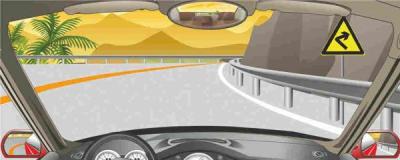
Answer:Y
19、The sign on the right side warns of crosswind on the mountain pass ahead.
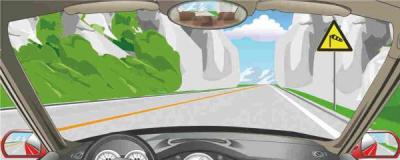
Answer:Y
20、had a head-on collision at the speed of 40 kilometers per hour with Mr. Wangs three-wheeled freight motorcycle carrying 19 passengers, killing10 people nd injuring 9. What are the main illegal acts committed by the two drivers?
A、Mr Ye drove an unpermitted vehicle type
B、Mr. Wang drove a freight motorcycle to carry passengers
C、Mr Ye exceeded the speed limit
D、Mr. Wang failed to follow the guidance of the traffic signal lights
Answer:BC
21、When driving on this dangerous mountainside road, motor vehicles should drive along the right side of the road.
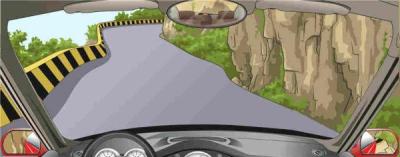
Answer:Y
22、If a motor vehicle is unable to drive in heavy fog on an expressway due to an accident, what should the driver do?
A、The driver and all passengers should promptly get off the motor vehicle from the left side door
B、Set up a warning sign 100 meters behind the vehicle in the oncoming direction
C、Turn on the hazard lamp and the high-beam
D、Stand in a safe place outside the guardrail
Answer:D
23、At this moment, the driver may speed up and pass the intersection rapidly.
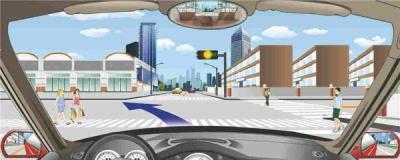
Answer:N
24、Motor vehicles on this kind of road are only allowed to overtake the vehicle in front from left.
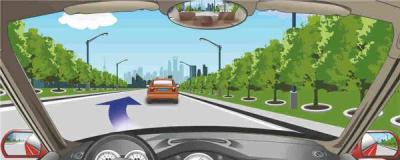
Answer:Y
25、When a motor vehicle passes over an inundated road the driver should change to a low gear and pass at a constant speed.
Answer:Y
26、When driving onto the left lane, motor vehicle drivers are allowed to make a U-turn.
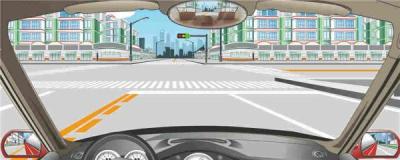
Answer:Y
27、The sign in front indicates a one-way lane after turning left.
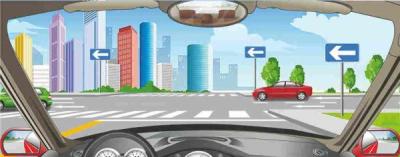
Answer:Y
28、Drivers may turn left when seeing these hand signals.
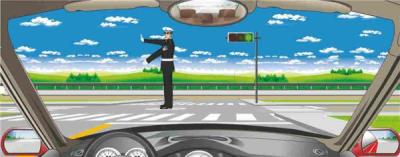
Answer:Y
29、Driving and smoking has no negative effect on safe driving
Answer:N
30、Under such circumstances, what should be done by the motor vehicle driver?
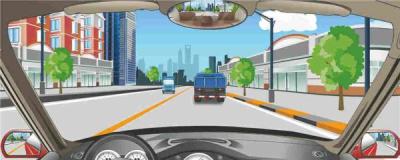
A、Overtaking the vehicle in front on its left
B、Overtaking by occupying the opposite lane
C、Overtaking the vehicle in front on its right
D、Following the vehicle in front
Answer:D
31、When driving on a muddy road, the driver should hold the steering wheel firmly and speed up to pass through.
Answer:N
32、The road marker indicates that vehicles are only allowed to turn right at the intersection ahead.
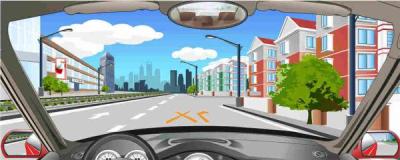
Answer:N
33、The sign on the right indicates a section for ascertaining the distance between the vehicles 200 meters ahead.
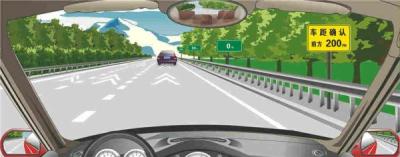
Answer:Y
34、What kind of harmful effect will be brought about by continuously using the foot brake on a long downhill road?
A、Shorten the engine's service life
B、Make the driver feel tired
C、Easily cause the vehicle to overturn
D、Reduce the braking efficiency
Answer:D
35、After setting off from the roadside, motor vehicle drivers should speed up as soon as possible and make a sharp left-turn in order to drive into the normal lane.
Answer:N
36、The sign on the right warns of a dangerous mountainside road on the left of the road ahead.
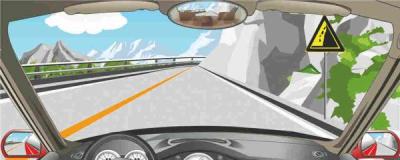
Answer:N
37、Mr. Qian drove a large sleeper coach with 45 passengers (capacity 40 people) at a speed of more than 40 kilometers per hour. On a long slope with sharp curves in Basu County, the coach fell into a 100-meter-deep valley, killing 17 people and injuring 20. What's the main illegal act committed by MrQian?
A、Making a cellphone call while driving
B、Speeding
C、Carrying more people than permitted
D、Fatigued driving
Answer:BC
38、When a motor vehicle skids sideways on a muddy road, the driver should turn the steering wheel in the direction of the rear wheel skidding to properly adjust the direction.
Answer:Y
39、The broken white line rectangle area on the right side of the road indicates that long stopping is permitted here.
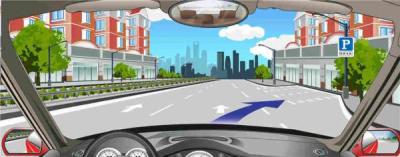
Answer:N
40、Under such circumstances, what should motor vehicle drivers do?
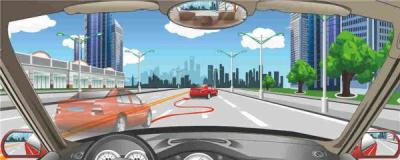
A、Overtake the vehicle quickly on its left
B、Keep a long braking space
C、Continuously sound the horn to alert the vehicle in front
D、Overtake the vehicle quickly from its right
Answer:B
41、When extinguishing fire, the synthetic-made garments should not be taken off in order to protect the exposed skin from burning.
Answer:N
42、When rescuing a wounded person suffering blood loss in an emergency, it is necessary to first stop the bleeding by compression before other treatments are taken in accordance with the conditions of bleeding.
Answer:Y
43、The sign on the right warns of low-lying road ahead.
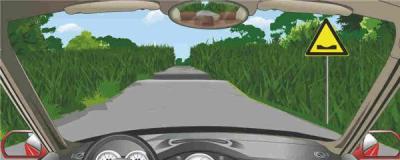
Answer:Y
44、What should the driver do when a motor vehicle encounters this situation on a mountain road?
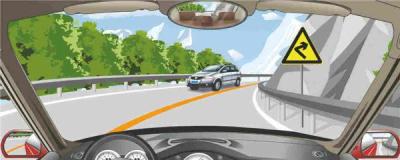
A、Stick to respective lanes and speed up to approach each other
B、Drive close to the central line of the road
C、Retain the normal speed
D、Slow down
Answer:D
45、When driving on an expressway, where should the driver park?
A、The service area
B、The acceleration lane
C、The deceleration lane
D、On the ramp
Answer:A
46、When driving on a road covered with ice and snow, the motor vehicle may spin or slide when increasing the speed urgently, due to the loss of vehicle stability.
Answer:Y
47、What should the motor vehicle driver do when the motor vehicle encounters the crosswalk in thissituation?
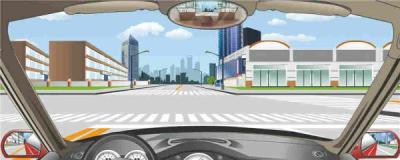
A、Slow down and pass
B、Speed up and pass
C、Sound the horn and pass
D、Stop immediately
Answer:A
48、When making a turn on a mountainous road, drivers should cut speed, sound the horn and drive along the right side.
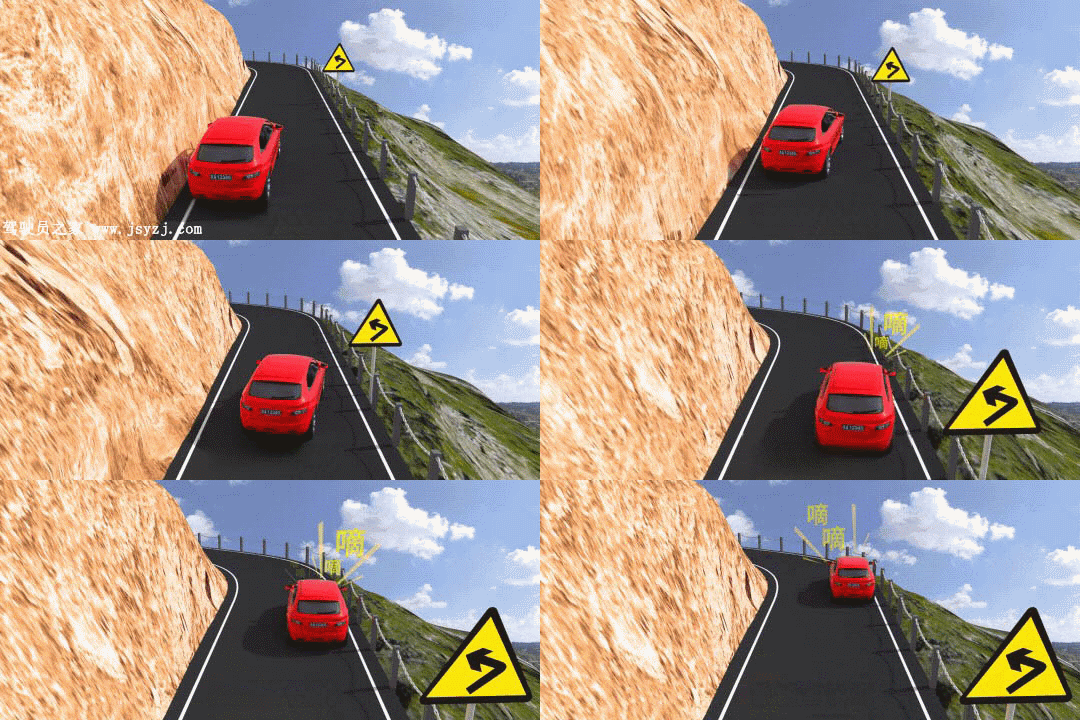
Answer:Y
49、What should the driver do when he/she sees this sign on the road?
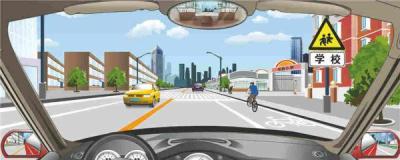
A、Use emergency braking
B、Slow down and take a look
C、Sound the horn intermittently
D、Prepare to bypass
Answer:B
50、When braking failure happens to a fast-moving motor vehicle, what should be done by the driver to brake?
A、Continuously depressing the brake pedal
B、Immediately changing to a low gear to reduce speed and using the handbrake
C、Swiftly depressing the clutch pedal
D、Swiftly pulling up the handbrake
Answer:B
- 上海驾考科目三英文 相关内容
- 陕西只认识英文可以考科目四吗 江西驾考科目四英语 湖北2025驾考英文题库 陕西科目四英文版模拟 老外在中国考驾照需要什么条件 河南驾考科目一英语 重庆科目四英文版题目 北京英文驾考书 福建科目四英文版模拟 宁夏英文驾考科目4 江西只认识英文可以考科目一吗 陕西驾照考试科目一英文版 山东驾考有英文版吗 上海外国人驾照到期换证地点 天津英文驾考科目四题库PDF电子版 湖南英文驾考题库PDF电子版
Copyright © 2025 驾考 版权所有